
Profile & Statistics
Discover Sept-Îles
Two cultures, one city

1908
The Clarke brothers build a pulp and paper mill in Clarke City
1921
Launch of the first ships from the Clarke Steamship shipyard
1927
Development of the first airstrip and beginning of air connections
1937
An Innu trapper discovers the first iron ore samples near Schefferville
1947
Creation of the Sept-Îles electricity company
1950
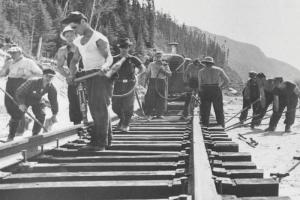
Start of IOC mining operations and construction of the railway to Schefferville
1951
Celebration of Sept-Îles' tricentennial
1960
Route 138 reaches Moisie
1962
The railway reaches Labrador City and Wabush
1989
Commissioning of Aluminerie Alouette
1994
Start of construction on the SM-3 hydroelectric complex
2002
Inauguration of Aluminerie Alouette phase 2
2010
First iron ore shipment from Consolidated Thompson
2012
Start of construction on the multi-user wharf
2014
Inauguration of the Alouette University Pavilion
2016
Creation of the Société ferroviaire et portuaire de Pointe Noire (SFPPN)
A meeting of peoples, a shared territory
Sept-Îles is above all a city of encounters. Here, two great cultures coexist and enrich each other: that of the North American First Nations and that of peoples from Europe. Together, they have woven for generations the unique identity of this northern territory—open, proud, and deeply rooted.
The non-Indigenous population speaks primarily French, but there is also a well-established English-speaking community with access to a full range of services in English, particularly in education and community life.
Nearby, the Innu community of Uashat mak Mani-Utenam represents virtually the entire Indigenous population of the region. A member of a First Nation of nearly 18,000 people, spread between the North Shore and Labrador, this community plays an essential role in the cultural and social development of the territory.
The Innu speak primarily Innu-aimun, their ancestral language, while also mastering French or English as second languages.
Throughout its history, Sept-Îles has built a multicultural identity marked by openness, respect, and exchange. This cultural blending is now its richness and appeal: a warm and welcoming land, where diversity is a strength and where every voice contributes to the collective story.
Languages spoken in Sept-Îles: French – Innu-aimun – English
An industrial city at the heart of an exceptional territory
Located on the majestic North Shore, within the MRC of Sept-Rivières, Sept-Îles forms, together with Port-Cartier, a strong and complementary regional hub. The city has more than 26,000 inhabitants, to which is added the neighboring Indigenous community of Uashat mak Mani-Utenam, with nearly 4,000 people. Together, they share a rich, vast territory vibrant with history.
Roots turned toward the sea and resources
The history of Sept-Îles is intimately linked to that of its resources. At the beginning of the 20th century, the forest was the economic engine of the region. But already, prospectors were traversing the northern lands, convinced that the subsoil held unsuspected treasures. Their intuition would prove correct: iron ore would give birth to a new city, built on work, boldness, and vision.
In the 1950s, the destiny of Sept-Îles shifted. This small fishing hamlet rapidly transformed into a modern industrial city, propelled by major mining projects: the IOC company, the Wabush mines, and the Scully mine in Labrador. Around these projects, wharves, terminals, dams, and plants were erected—infrastructure that would make Sept-Îles a nerve center of northern development.
An economy in transformation
Like any major industrial port, Sept-Îles has experienced its cycles: periods of growth, crisis, and renewal. In the 1980s, the iron crisis shook the North Shore, forcing the restructuring of many companies. But the resilience of Sept-Îles did not waver. In 1989, the arrival of Aluminerie Alouette brought new economic vitality and marked the beginning of a new era.
The following decades confirmed this momentum:
- 1990s: construction of the Sainte-Marguerite-3 (SM-3) dam, a symbol of regional hydroelectric power.
- 2000s: expansion of Aluminerie Alouette (phase 2) and opening of new mining sites, including Consolidated Thompson in 2010. These investments consolidated Sept-Îles’ position as the industrial and economic metropolis of the North Shore.
A resilient city, focused on the future
Despite fluctuations in the mining market, Sept-Îles remains a resilient city, capable of reinventing itself. Today, it combines energy, expertise, and innovation to build a sustainable future, where industry, nature, and community coexist harmoniously.
Inhabitants
km² of land area
Socio-economic
profile
Sept-Îles at a glance
A territory of opportunities, a strategic location
At the heart of the North Shore, Sept-Îles stands out for its unique balance between exceptional environment and strategic economic development. Bordered by a natural bay of 45 km² protected by an emblematic archipelago, the city benefits from a privileged location on the St. Lawrence Seaway.
Sept-Îles is recognized as a major industrial hub in Canada. Its deep-water port (the largest ore port in North America) offers direct access to global and North American markets. Located midway between the Great Lakes and the Atlantic Ocean, the city is an essential logistics gateway for international trade.
Rich in natural resources, industrial expertise, and modern infrastructure, Sept-Îles is a place where projects take shape, where businesses grow, and where the future is written to the rhythm of innovation and sustainable development.
Population: ~30,000 INHABITANTS (Sept-Îles and Uashat mak Mani-utenam)
Country: CANADA
Province: QUEBEC
Administrative region: NORTH SHORE
Land area: 2,182 KM²
Climate: BOREAL WITH COOL SUMMER AND MILD WINTER
Socio-economic statistics
A city of energy and boldness, Sept-Îles has more than 1,000 businesses that shape the regional economy every day. Some develop the territory’s resources (sea, peat, forest, steel) while others innovate and export their expertise around the world. Cutting-edge technologies are developed here, heavy machinery is repaired, high-performance hydraulic products are designed, and vital maritime infrastructure is maintained.
Sept-Îles is a territory of the future driven by people who are proud, ingenious, and deeply attached to their community. A city where economy and nature move forward together, toward the same horizon.